Existing visual navigation models often aim to develop foundation models that can generalize robot navigation across diverse platforms. However, many of these models are prone to collisions when deployed in complex indoor environments, particularly in structured layouts and narrow passages. To address this problem, we propose a depth image- and point-goal-conditioned navigation system, DevGRU. The proposed system employs an action predictor (AP) that generates collision-aware future trajectories, enabling effective avoidance of immediate obstacles. In conjunction with a collision predictor, the AP further compensates for errors accumulated in the goal pose estimation and proactively mitigates future deviations. To evaluate our method, we conducted experiments across nine different scenes and three state-of-the-art approaches—ViNT, NoMaD, and NavDP—as well as four additional variants of ViNT and NoMaD. In terms of navigation performance, DevGRU significantly outperforms ViNT and NoMaD by a large margin. In addition, the proposed model has a relatively small number of trainable parameters, resulting in the fastest inference time among the baselines, particularly outperforming NavDP by 7× in model size and 17× in inference time.

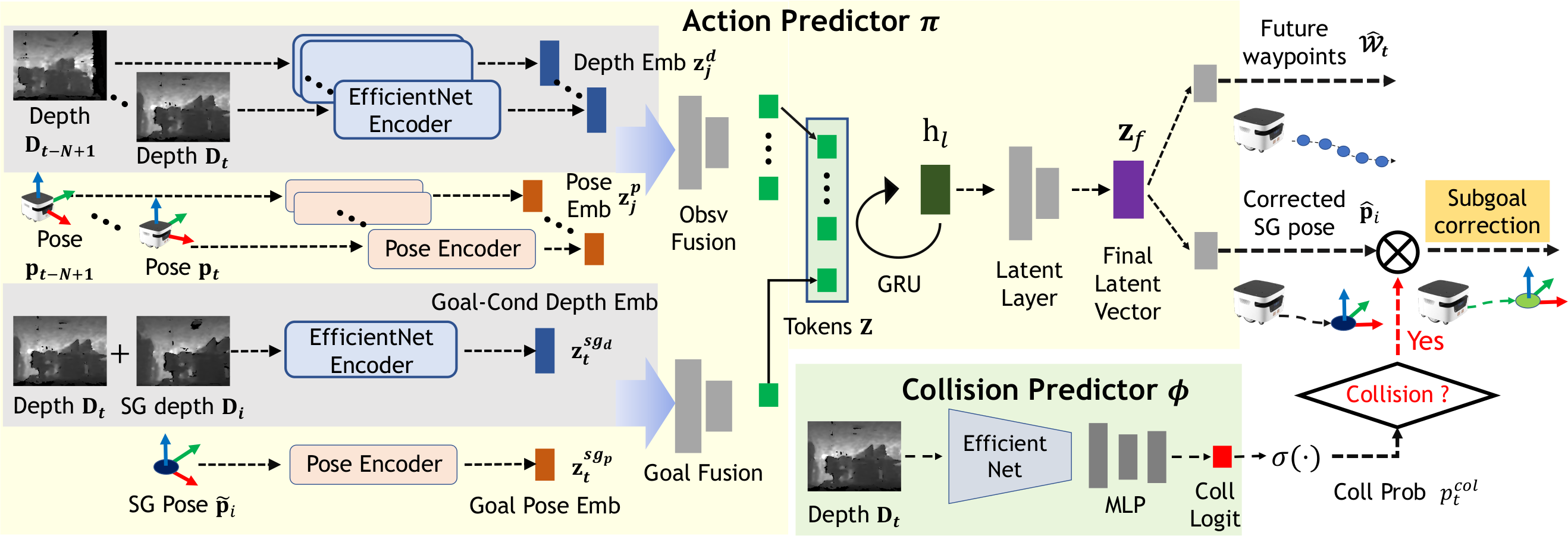
Overview of the DevGRU architecture and navigation pipeline.
DevGRU navigates through visual subgoals in a topological map. It uses depth images that directly encode scene geometry. The action predictor consumes recent depth and robot-pose observations with the target subgoal, then predicts a short collision-aware waypoint trajectory and a corrected subgoal pose.
EfficientNet-B0 encoders produce depth and goal features, pose encoders represent robot and subgoal configurations, and a GRU captures temporal dependencies. This compact design is trained with approximately 10K collision-free and 10K collision-intensive samples.
A depth-based collision predictor estimates imminent collision likelihood. When risk is high, the corrected current subgoal offset is propagated to future subgoals, reducing accumulated odometry error instead of only reacting to the obstacle immediately ahead.
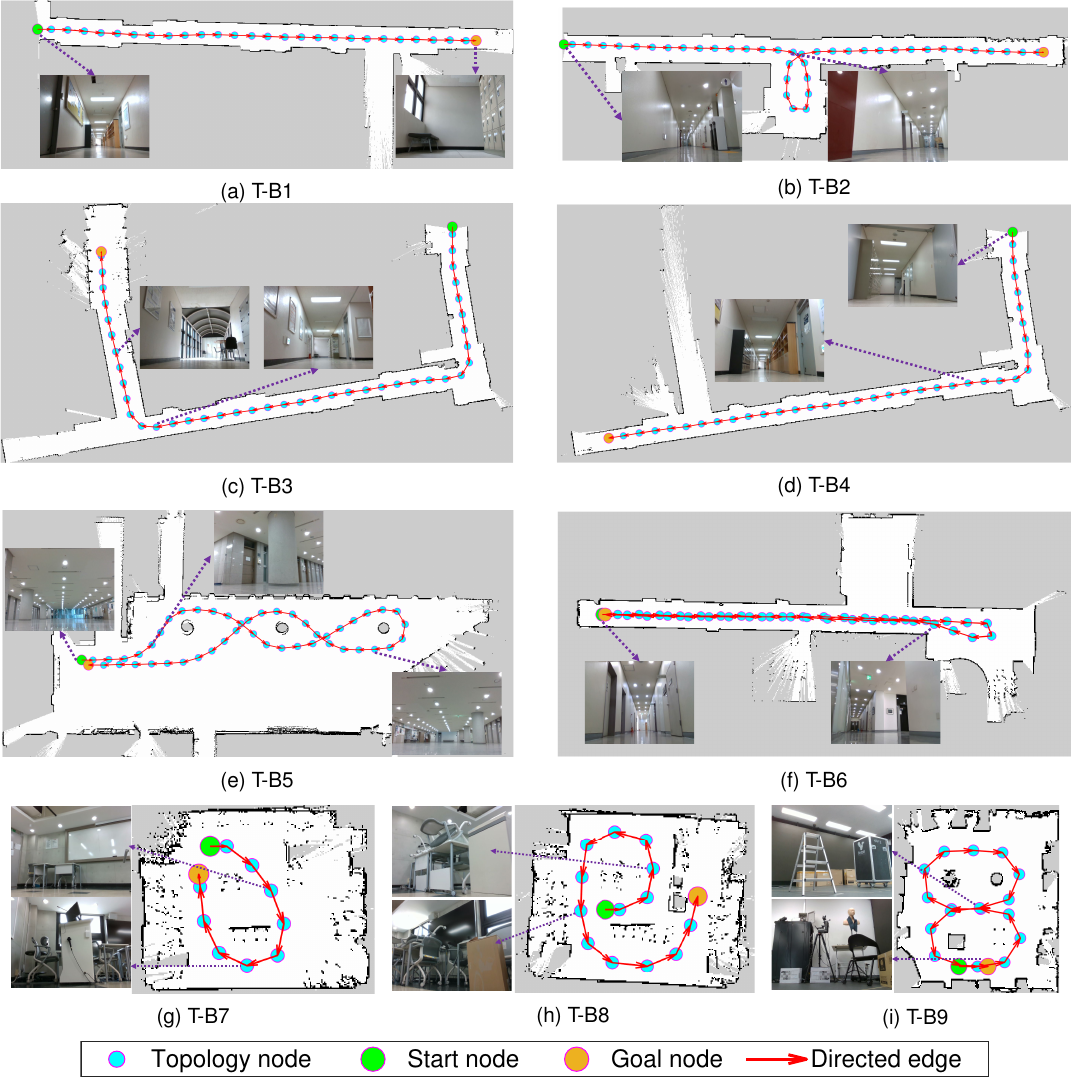
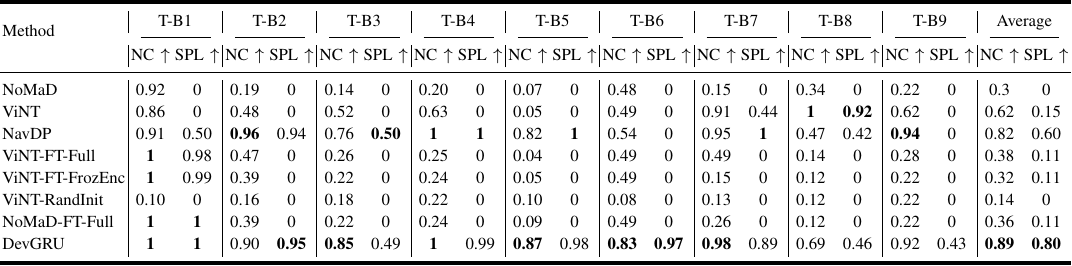
We evaluated all methods twice on nine topological maps in six unseen campus locations, with paths from 12.14 m to 65.3 m. DevGRU achieved the best average Node Coverage (NC) of 0.89 and Success Weighted by Path Length (SPL) of 0.80. In T-B6, DevGRU was the only method to complete the full route.


DevGRU combines strong navigation performance with a compact and efficient recurrent architecture. It uses 19.44M parameters and requires only 50.01 ms per inference, making it approximately 7× smaller and 17× faster than NavDP. Inference time was measured on the robot's driving laptop, equipped with an AMD Ryzen 9 6900HX CPU (1.6 GHz) and an NVIDIA RTX 3070 GPU, using the same hardware setup for all compared models.
| Model | Parameters (M) ↓ | Mean inference time (ms) ↓ |
|---|---|---|
| NoMaD | 19.05 | 123.46 |
| ViNT | 29.67 | 176.57 |
| NavDP | 135.72 | 860.18 |
| DevGRU | 19.44 | 50.01 |
@article{han2026devgru,
author = {Kyung Min Han and Eunsom Kim and Young J. Kim},
title = {DevGRU: Depth-guided Visual Navigation using a Collision-aware Recurrent Model},
journal = {IEEE Robotics and Automation Letters},
year = {2026}
}